Fatal Infection

A few people asked for this. And I was curious about it too. So here it is. Case fatality rates for well-known diseases.
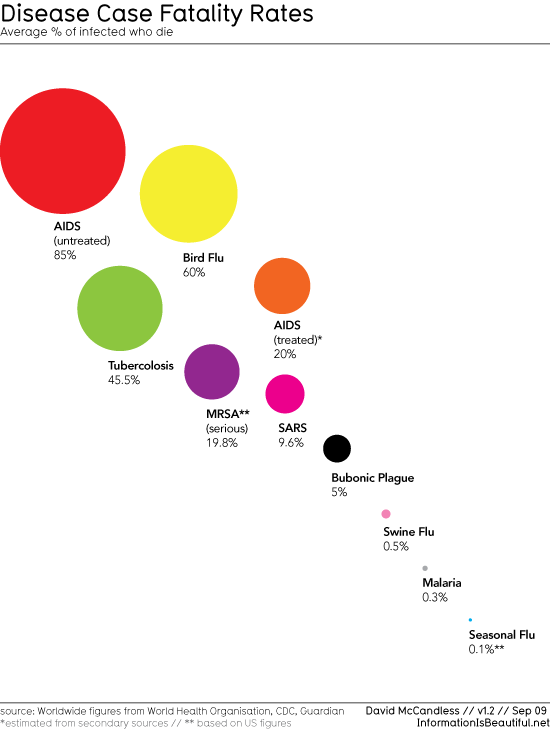
Case Fatality Rates for Well-Known Diseases
This was very hard to research. The AIDS/HIV figures are especially difficult to find. Many of the numbers are locked into the tables of 1,000,000 page PDF reports. Grrrr!

(I tell you – when I sleep these days, my dreams unfold in rows and columns…)

Anyway, if anyone can find tighter, better figures, or can think of any key diseases I’ve missed (preferably with data!), please get in touch.


UPDATE 1: I’ve added this. Thanks to Gorka Cortazar for the suggestion.
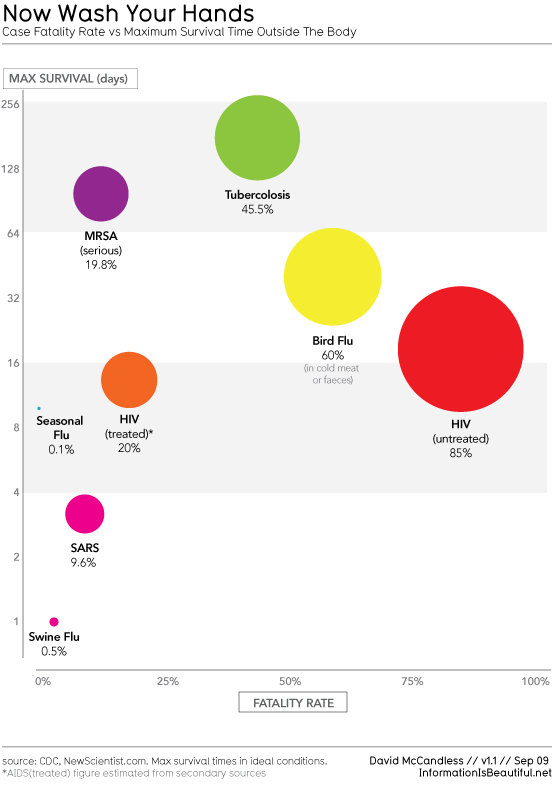
Disease Fatality rate vs Survival Time Outside Of The Body

UPDATE 2: I’ve edited the Seasonal Flu fatality figure, previously 9% to 0.1%. The original figure was based on the number of patients *severely* ill with ‘flu who died, not the overall number of infected people. Sorry for the error. (Thanks to Lucie Melahn for the correction). I’ve also reclassified MRSA to “serious” or invasive MRSA.

Related posts
Posted in Data Visualisation, Disease, Health, Infographic.
GET THE permalink
Post a comment or leave a trackback.


35 Comments

  1. Posted September 24, 2009 at 12:49 pm | Permalink

    Excellent! However you may wanna include either the population infected with the aforemention or the probability of getting infected.

    Malaria is so far a much larger killer than portrayed, in terms of fatalities, than SARS, all flus and TB combined :-/

  2. Rose
    Posted September 24, 2009 at 1:03 pm | Permalink

    Since AIDS is a non-acute illness that can’t be cured, you might want to say what period this % rate is over e.g. 5 years, 10 years…

    Also, are people who die of TB & have AIDS counted in the TB category as well as the AIDS category, or just in AIDS (since many people with AIDS die from TB). Just wondering because if they were counted in TB, that would really skew the fatality rate. I don’t know how much people with AIDS are affected by other infections on the chart such as MRSA.

    Is the data worldwide or from particular countries?

  3. Posted September 24, 2009 at 1:47 pm | Permalink

    Good work, and very interesting. Could you post the source data as well, with numbers and source URLs for the individual diseases?

  4. david
    Posted September 24, 2009 at 1:50 pm | Permalink

    It’s worldwide data (where available)

    See here for the all sources & data

    http://spreadsheets.google.com/ccc?key=0Aqe2P9sYhZ2ndDhPaU9fOVVlYUVGSzVWSWROTmF1UVE&hl=en_GB

  5. Posted September 24, 2009 at 2:22 pm | Permalink

    Is it possible that the figure for number infected with flu is artificially low due to most people not bothering to see a doctor about it? 9.4% fatality rate seems awfully high, even considering high risk populations.

  6. Posted September 24, 2009 at 2:46 pm | Permalink

    Seasonal flue is 9+%? That seems very high. I did a quick search and found e.g. < 0.1% – "similar to swine flu" etc. If your numbers are correct, I'm hiding under my bed :)

  7. Lucie Melahn
    Posted September 24, 2009 at 5:33 pm | Permalink

    Seasonal flu has a mortality rate of less than 0.1%. You seem to have used the numbers for P and I (or Pneumonia and Influenza) which is a completely different thing. A two second search on google will show the real mortality rate for seasonal flu.
    Also, the WHO and other health organizations have no idea what the mortality rate for H1N1 is — because the pandemic is just getting started.

    Nice idea, though.

  8. Lucie Melahn
    Posted September 24, 2009 at 5:38 pm | Permalink

    from your WHO source: “Worldwide, these annual epidemics result in about three to five million cases of severe illness, and about 250 000 to 500 000 deaths. ” There is a big difference between “cases of severe illness” and all cases. Severe illness refers to cases requiring hospitalization, which is a small minority of flu cases. So 9% of people who are hospitalized for seasonal flu die from it, which is not at all the same as 9% of all people who catch flu. Your number there is off by a factor of 100 at least.

  9. david
    Posted September 24, 2009 at 7:27 pm | Permalink

    @G))))) ManFlu is a dramatic illness well known in the UK whereby a man, stricken with a mild common virus, instantly takes to his bed, believes he is dying, is unable to perform the simplest task, and demands round-the-clock attention from his female friends. That’s what it’s like for me, anyway :)

  10. david
    Posted September 24, 2009 at 7:28 pm | Permalink

    @lucie melahn – thanks – great feedback. I will amend.

  11. Lucie Melahn
    Posted September 24, 2009 at 10:01 pm | Permalink

    Hi David. Hope that helps a bit. Epidemiologists talk about the morbidity and mortality of a disease. Mortality is what you have illustrated here. Morbidity means how many people get infected by the disease (how contagious it is). Interestingly for the diseases you used, the chart would look almost the opposite. HIV is relatively speaking not that contagious, but influenza is extremely contagious. It might be interesting to compare the two.

    The important thing to know is that mortality alone is not the only criterion for deciding whether a disease poses a public health risk. It gets the most headlines, though.

  12. Posted September 24, 2009 at 10:24 pm | Permalink

    Tuberculosis is the one that worries me most on that chart–SO many people infected worldwide and it is becoming increasingly drug resistant. Sure, it takes a long time to kill you, but quite unpleasant. Of course, if bird flu became easily transmissible while keeping its virulence we would certainly see a world-changing pandemic!

    Thanks for compiling this! No pressure, but now we expect you to pull a Hans Rosling with your data! http://www.ted.com/talks/hans_rosling_the_truth_about_hiv.html

  13. danny
    Posted September 25, 2009 at 5:49 pm | Permalink

    Isn’t AIDS fatal in 100% or how is this defined? You could include smoking (50% fatality rate)…

  14. Sam
    Posted September 25, 2009 at 9:06 pm | Permalink

    What is the size of the bubble dictated by? Is it just a redundancy of the percent? Is it noted somewhere that I missed?

  15. crocodilexp
    Posted September 26, 2009 at 7:49 pm | Permalink

    Over which period do you define mortality rates? 5 years? 10 years?

    If period is indefinite, mortality is always 100% (we all die). This is particularly relevant for chronic diseases — cold sores are incurable and correlate with certain death given the long-enough timeframe.

  16. Denise
    Posted September 27, 2009 at 5:25 pm | Permalink

    Not sure what you mean when you talk about fatality due to MRSA. MRSA is incredibly widespread, and if 19 percent of people who contracted it died, we’d have a major plague on our hands. In many regions of the country, the majority of skin infections (i.e. boils) are MRSA. Maybe you are talking about fatality if someone develops some kind of systemic MRSA infection?

    http://www.skininc.com/skinscience/physiology/28502439.html
    http://www.cdc.gov/ncidod/dhqp/pdf/guidelines/MRSA_tagged.pdf

  17. Posted September 27, 2009 at 10:37 pm | Permalink

    Seasonal flu indeed has a Case Fatality Ratio of less than 0.1%, the figure 9.4% is dead wrong and misleading. By the way no one really knows the CFR of Swine Flu as well, 0.5% is just the latest upper estimate based on a mixture of epidemiological data and statistical modelling.

    Also, mortality is not the same as the case fatality ratio. Mortality is the annual number of deaths divided by the whole population (usually expressed as deaths per 100.000 population per year), whereas the CFR is the proportion of deaths out of all people infected.

    A disease can have a high CFR but a low mortality, if it has a low incidence (=annual number of new infections / population), and vice versa. For acute infectious diseases (no chronic infection):

    mortality = incidence x CFR

    Therefore swine influenza is considered a serious public health risk, because although it has a low CFR (<0.5%) it is bound to infect lots of people (up to 30% of the entire population during the winter in the northern hemisphere), thereby causing many deaths.

  18. nicola
    Posted September 28, 2009 at 10:10 am | Permalink

    is this for a specific year or for all time? I’m amazed bubonic plague isn’t higher if it is for all time, and also can’t believe bird flu’s so high!!

  19. nicola
    Posted September 28, 2009 at 10:12 am | Permalink

    also @danny – smoking isn’t a disease

  20. Lucie Melahn
    Posted September 28, 2009 at 4:55 pm | Permalink

    Wow, this has been tweeted and digged all over the universe without being amended or annotated. I hope these very misleading numbers don’t cause anyone to make bad choices about their health regarding swine flu.

    as for bird flu being so high, it is currently not a major public health threat because it is not easily spread from person to person. There is only one known case of a person catching it from another person. If that flu were to mutate into a more contagious form, we would have a serious problem. We have no way to know the likelihood of that happening.

  21. Lucie Melahn
    Posted September 28, 2009 at 7:56 pm | Permalink

    David, thanks for updating it. I don’t like to harp but I saw a few tweets and hate the idea of this information being misused.

  22. Posted October 2, 2009 at 9:59 pm | Permalink

    Nice…though you’d get even more dramatic results if you compared the total deaths from swine flu since it first broke out in the spring to those from heart disease, cigarettes, and car accidents in the same time period…

  23. Jay W Friedman
    Posted October 8, 2009 at 3:36 pm | Permalink

    So what are you trying to say: one should or should not get Flu Shots?
    If you think not, recall that a 0.1% case fatality rate equals tens of thousands of deaths each year.

  24. Nick
    Posted October 14, 2009 at 2:29 pm | Permalink

    I think the fatality rate for bubonic plague is actually 90%. And people, the 9.4% fatality rate belongs to SARS, not seasonal flu!

  25. austin
    Posted October 15, 2009 at 8:06 pm | Permalink

    Re: fatality graph you are saying “if I contract X disease today, my chances of dying are Y”. But actual risk is also tied to the rate of infection. Another (more interesting?) graph would be “I have X chance of contracting Y disease and Z chance of dying from it”

  26. Posted October 22, 2009 at 4:08 pm | Permalink

    I think a graph of case fatality rate (number of deaths out of number of sick people) vs. attack rate (how many get sick out of those exposed) would have been helpful. The number of people who have actually gotten bird flu is relatively miniscule – a few hundred in the whole world, ever, and it’s been found that many people exposed to sick poultry (e.g. workers in live bird markets) have antibodies against it, meaning they got infected but weren’t noticeably sick and cleared the infection. http://www.who.int/csr/disease/avian_influenza/country/cases_table_2009_09_24/en/index.html

  27. chillman
    Posted October 24, 2009 at 6:20 pm | Permalink

    According to the latest CDC numbers (obtained from flucount.org) the world wide fatality rate for H1N1 is 1.13%.

    Case fatality in the U.S. is higher, at 1.61%.

    That is roughly half the rate of the 1918 outbreak which killed 50 to 100 million people world wide.

  28. Posted October 27, 2009 at 8:13 pm | Permalink

    I believe your graph is scaled incorrectly.

    It seems you’re determining circle size by matching the radius to the fatality rate instead of the matching total area to fatality rate, so AIDS (untreated), with a 85% fatality rate is 22x the area of Bubonic Plague, instead of the expected 17x, and more than four thousand times as large as seasonal flu, instead of the expected 850x!

    It’s possible I’ve mis-measured (admittedly I just used the webdeveloper extension’s ruler instead of zooming all the way in photoshop), but I think you just need to change how you’re determining circle size. The circle’s radius should be sqrt(desired final area * pi), instead of (desired area * scaling factor).

    I could be totally off base here, but working with area in charts is tricky, and this is a common mistake.

  29. Belshazzar
    Posted October 27, 2009 at 11:20 pm | Permalink

    If the y-axis metric is survival time outside the body, shouldn’t the two HIV datapoints have the same y-value?

  30. Posted November 7, 2009 at 2:00 pm | Permalink

    Thanks for such a nice post. It is very informative post. I am wondering if I can share your article in the bookmarks of society

  31. Chobr
    Posted November 11, 2009 at 8:14 pm | Permalink

    Love the chart, as long as reasonable caveats taken when interpreting it. Specifically, the difficulties encountered in collecting accurate and comparable data on different diseases. As has been stated, many infections will never be formally diagnosed, seasonal flu being the prime example. Thus, the case fatality rates will either be abnormally high if based on known cases, or would have to be based on estimates and extrapolations on known data.

    It has been estimated that approximately 1/3 of the world’s population has been infected with tuberculosis – by your figures with a case-fatality of almost 50%, that would consign about a billion people to a consumptive death. The discrepancy is in the distinction between TB infection (which in many people can lie ‘dormant’ in what is termed ‘Latent TB Infection’ and does not cause symptoms or kill people) and tuberculosis the disease, which is the clinical manifestation of rampant TB infection. It is the actual disease that has the high mortality. Lastly, ‘tuberculosis’ has been spelled wrongly on the charts!

  32. Chobr
    Posted November 11, 2009 at 8:16 pm | Permalink

    Should add that latent TB infection can reactivate years later and manifest as actual tuberculosis, which is why contact tracing, case-identification and treatment of even asymptomatic individuals is important.

  33. Andrew Kandel
    Posted November 14, 2009 at 11:03 am | Permalink

    minor comment, but you might want to spell check “tuberculosis”

  34. Dr Feelgood
    Posted December 12, 2009 at 7:18 pm | Permalink

    @Belshazzar “If the y-axis metric is survival time outside the body, shouldn’t the two HIV datapoints have the same y-value?”

    That one threw me off too. Looks like the chart draws the circle ABOVE the data point, rather than centered on the point.

  35. Posted January 10, 2010 at 7:48 pm | Permalink

    Отлично написано. А это все на основе личного опыта?Позвольте поинтересоваться :)

20 Trackbacks

  1. [...] This post was mentioned on Twitter by João Paulo de Paiva and Info=Beautiful. Info=Beautiful said: New: viz Fatal Infection http://bit.ly/2H0jme [...]

  2. [...] Blog, wo man allerhand nütze, wie unnütze, Informationen herbekommt, heute einen Überblick, wieviel Prozent der Infizierten bei bestimmten Infektionen dann auch dahin gerafft werden, im Überblick scheint die Aufregung um die Schweinegrippe umso mehr [...]

  3. By Schweinegrippe | Die Schreibtischwerkstatt on September 24, 2009 at 1:02 pm

    [...] Hier gefunden [...]

  4. By Fatal Infection | Lick My Chip ! on September 24, 2009 at 1:25 pm

    [...] Infection Via Information Is Beautiful by [...]

  5. [...] Fatal Infection | Information Is Beautiful [...]

  6. [...] (Depuis Information is beautiful) [...]

  7. By take that mask off already « urban taster on September 26, 2009 at 10:15 am

    [...] leave a comment » via Information is Beautiful [...]

  8. [...] vient de consacrer un de ses récents posts aux données relatives aux maladies infectieuses, à partir de sources comme l’OMS, le CDC et le [...]

  9. By thore.no » Information is beautiful on October 7, 2009 at 9:36 pm

    [...] not so much fun, but wonderful presentation is the plot of Disease Case Fatality Rates for different well-known diseases. It strengthens my belief in the Swine-Flu as something which [...]

  10. By Information is Beautiful | THESCRAPBOOK on October 19, 2009 at 10:49 am

    [...] of digital distractions? How to get replies in online dating? Fatality rates of diseases? Inforamation is Beautiful has them [...]

  11. By Chriss´ Blog on October 27, 2009 at 5:10 pm

    Schweinegrippe & Co….

    Hier mal eine -wie ich fand- sehr interessante Grafik, welche die Letalität verschiedener Krankheiten nebeneinader darstellt. Letalität meint die “Tödlichkeit” einer Krankheit als Verhältnis der Anzahl der an einerKrankheit Verstorbenen……

  12. [...] Information is Beautiful [...]

  13. [...] via Information is Beautiful [...]

  14. [...] Information is Beautiful [...]

  15. [...] is a wonderful graphics from the Information is Beautiful website, showing the relative seriousness of swine flu compared [...]

  16. By Fatal Injection | MOMOKO MASHUPS on November 19, 2009 at 12:08 am

    [...] Information is Beautiful | Fatal Infection [...]

  17. [...] is a wonderful graphics from the Information is Beautiful website, showing the relative seriousness of swine flu compared [...]

  18. [...] colección de infografías sobre las enfermedades más letales (o populares) del mundo, como el HIV, la tuberculosis y la [...]

  19. [...] Chart via Information is Beautiful [...]

  20. By H1N1 Not So Deadly After All . . . | The Big Picture on December 11, 2009 at 7:26 pm

    [...] via Information is Beautiful [...]

What did you think?

Your email is never published nor shared. Required fields are marked *

*
*

You may use these HTML tags and attributes: <a href="" title=""> <abbr title=""> <acronym title=""> <b> <blockquote cite=""> <cite> <code> <del datetime=""> <em> <i> <q cite=""> <strike> <strong>

  • Like this? Subscribe for more
    Web Feed Twitter