How I Learnt To Stop Worrying And Love The Bomb (Kinda)

UPDATE: Aug – I’m in the process of revising this diagram in light of all the comments (and flames!). Thanks all. If you can help me research the data, please email
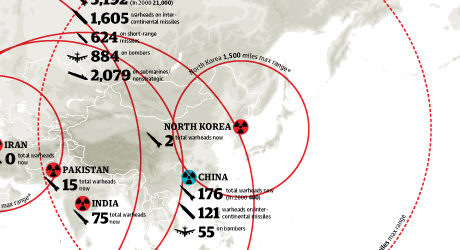
I felt alienated from The Guardian’s graphic about stockpiles of nuclear weapons.

Guardian's Nuclear Weapons graphic

I felt the use of abstract figures made most of the data meaningless. Russia has 5192 warheads. America 4102. France 300. What does that mean? Is that a lot? I can’t relate to that.

There’s a single way I relate to nuclear weapons. By their destructive capability. I grew up watching Threads and The Day After. We were even made to watch those nuclear horror films at school. Those films branded our minds with the idea that nuclear weapons could destroy the world. They are Doomsday devices. They kill everybody. Nuclear War = End Of The World.

So, I thought of a better way to understand the data. Dump the raw totals. Instead visualize the stockpiles by how many times over they could destroy the world.  Yeah cool! And that would actually expose the ludicrous stupidly of nuclear weapons at the same time. *So clever*.

However, the idea rapidly unravelled. Here’s why…
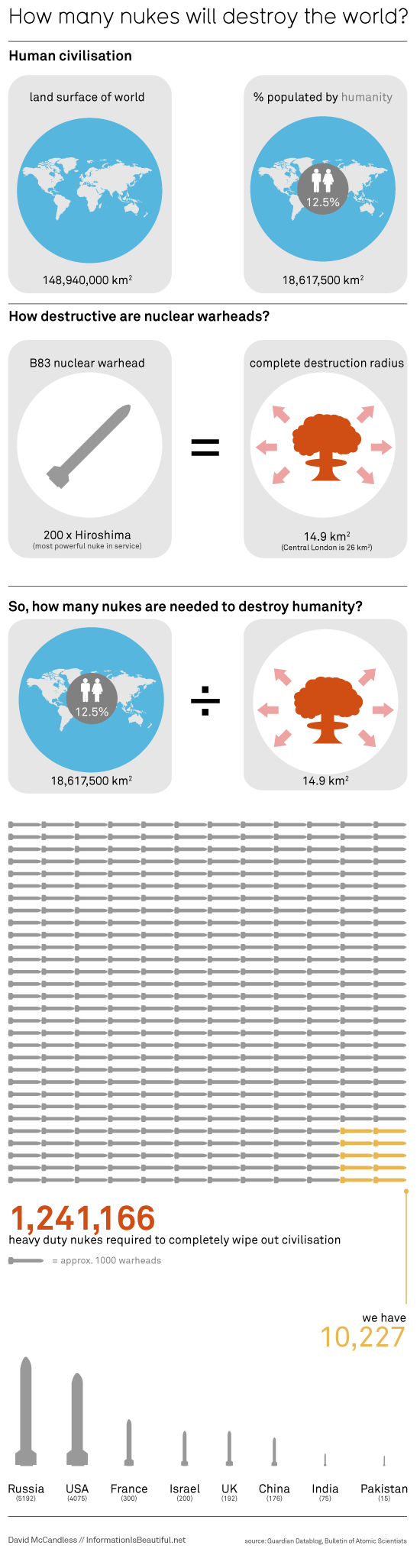
How Many Nukes Will Destroy The World?

I wasn’t expecting that. We only actually have 0.83% of what’s required to completely wipe out civilisation. We couldn’t do it if we wanted to.

10 years ago we had 32,512 nuclear weapons. That’s a much better 2.6%. God damn you Non Nuclear Proliferation Pact!

Ah but we all live in cities now

I tried to recover a eye-popping stat with another quick calc. 50% of us live in densely populated cities now. Maybe we could wipe out all city-dwelling humanity. YES!

Nope. Still no good.
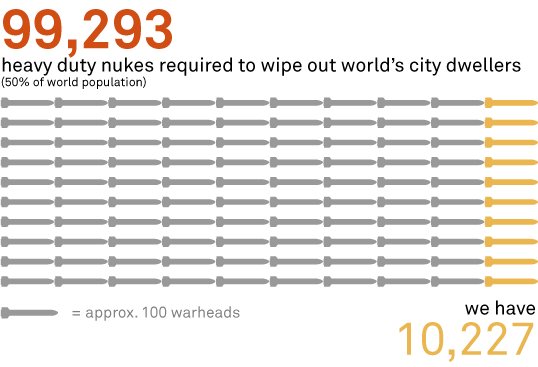
Unexpectedly, in making this image, the data forced me to change my mind.

In this case, it exposed the myth in my head, scorched long ago into my childhood imagination. The scene of many nightmares. That nuclear weapons could kill everything. Could wipe out civilisation.

No doubt, nuclear weapons are crazy devices. In the hands of mad people and mad regimes, they have a nightmarish potential for devastation. But they are not the end of humanity.

As the data reveals, we simply don’t have enough of them.


source: Guardian Google Docs, Wikipedia


Posted in Data Journalism, Infographic, Visual Journalism.
GET THE permalink
Post a comment or leave a trackback.


131 Comments

  1. DCN
    Posted February 9, 2010 at 8:08 pm | Permalink | Edit

    @CBM, lost of American testing was done mostly nevada. but then you have to look at the soviet union, china, india, pakistan, france, the UK, etc. who didn;t have access to nevada as a nuclear test site.

    And most of our(American) thermonuclear(the big/modern kinds of nukes) testing was done in the south pacific.

  2. Robo Sapien
    Posted February 15, 2010 at 3:47 am | Permalink | Edit

    Contrary to these graphs, the fact of the matter is that it would only take ONE (1) bomb to kill both Brad Pitt and Angelina Jolie. The fallout from such an event would unravel society as we know it. Those who don’t immediately kill themselves would certainly die in the anarchy that ensued.

    Next time, try factoring in Brad and Angelina, Mr. Smartypants graph maker!

  3. Posted February 16, 2010 at 2:19 pm | Permalink | Edit

    This is FASCINATING! Beautiful work. Really awesome.

    I just have to ask, tho… what about fallout and nuclear winter?

    Or is nuclear winter just counterbalanced by climate change? (ha ha).

  4. Posted February 17, 2010 at 3:12 am | Permalink | Edit

    I think the environment would be rather polluted from the radio active fallout if all 10.227 nukes was brought to explosion. It would not be the end of the world, but I´m afraid it would be the end of the world as we know it.

  5. Keith
    Posted February 28, 2010 at 8:54 pm | Permalink | Edit

    The Nuke that destroyed Hiroshima is not by any means the most powerful bomb in service.
    So if you’re using that as a reference for your data, you’re not going to get accurate forecasts for our possible demise.
    There are plenty of nukes way more destructive than the B83.
    The best example I can think of would be the ACTUAL most powerful nuke ever detonated…
    The AN602 also known by many other nicknames such as “Tsar Bomba” or “King of Bombs”.

    It used a nuclear weapon yield of 50 megatons. This is equivalent to 1,400 times the combined power of the two nuclear explosives used in World War II; Little Boy (13-18 kilotons) and Fat Man (21 kilotons), the bombs that destroyed Hiroshima and Nagasaki.
    In fact, when the soviet union decided to test it, they only used HALF of it’s explosive capabilities for fear that using it at maximum capacity would result in radioactive fallout.
    The initial three-stage design was capable of approximately 100 Mt, but would have caused too much radioactive fallout. To limit fallout, the third stage and possibly the second stage had a lead tamper instead of a uranium-238 fusion tamper (which greatly amplifies the reaction by fissioning uranium atoms with fast neutrons from the fusion reaction). This eliminated fast fission by the fusion-stage neutrons, so that approximately 97% of the total energy resulted from fusion alone.
    Even after deactivating it’s fullest potential, it was still the most powerful bomb in the world.
    And the effect was felt from around the world.
    Here’s a video on youtube I just found with all of the fact in the video description.
    http://www.youtube.com/watch?v=LxD44HO8dNQ

  6. Gealouple
    Posted March 3, 2010 at 12:50 pm | Permalink | Edit

    The action taken to local and national disasters is great but it’s a damn shame that so many citizens take advantage of the negative situations.

    I mean everytime there is an earthquake, a flood, an oil spill – there’s always a group of heartless people who rip off tax payers.

    This is in response to reading that 4 of Oprah Winfreys “angels” got busted ripping off the system. Shame on them!
    http://www.cbsnews.com/blogs/2009/08/19/crimesider/entry5251471.shtml

  7. Posted March 6, 2010 at 10:26 am | Permalink | Edit

    Did you have a look at any *authoritative* studies or just rely on your (impressive) native wits?

    Your illustrations are great but I’m thinking that there might be more to this than just some simple calculations…

    Think about the damage and cost inflicted by the 9/11 attacks. The total area destroyed was relatively tiny, but the consequences for the world were profound.

    Or think about the ‘crisis’ caused by electricity blackouts, or internet failures that happen from time to time and destroy no real estate.

    Do you really think that life in the UK, for example, would continue in any meaningful sense if every City was partially destroyed by even a small nuke each? No electricity, almost no communications, no water or sewage, no news, almost no surviving doctors, few deliveries of imported or domestic food, radiation pollution, vast numbers of injured people, barely any law and order….

    Your other visualisations are great but this one needs to go back to the drawing board.

    Like you, I grew up under the ‘nuclear cloud’, so I am interested to see you do it again with more sophisticated thinking, that captures the impact of a nuke on the complex systems that sustain our cities.

  8. Mark K.
    Posted March 6, 2010 at 11:29 pm | Permalink | Edit

    While insightful, this illustration only shows what it would take to destroy the inhabitable landmasses of Earth. But you completely ignore the environmental impact a nuclear warhead has. You’ve heard of a nuclear winter yes? It would only take a fraction of the nukes we currently have to make the surface of our planet uninhabitable through, not a massive explosion, but by radiation, and the effect of massive amounts of dust and debris being thrown into the atmosphere.

  9. Posted March 11, 2010 at 1:37 am | Permalink | Edit

    It’s a relief to know that we can’t destroy the world!

  10. Daniel
    Posted March 15, 2010 at 5:30 am | Permalink | Edit

    You are, however, ignoring the side-effects of open-air nuclear detonation. Taking the Hiroshima bomb as an example, the instant deaths are estimated at about 66,000. Deaths due to radiation contamination are estimated at 69,000. For about three generations in the areas of Hiroshima and Nagasaki were very significantly heightened levels of other disorders such as leukemia.

    You also fail to take into account the types of bombs. The aforementioned ones were fairly low-yield – using today’s technology in design and manufacture the same bombs, using the same amount of fissionable material, would be about 12 times more powerful. In addition to just fission bombs we also have fusion and neutron bombs. Fission and fusion are fairly “dirty” with very long-lasting background contamination while neutron bombs are hugely “dirty” but with a very short half-life of contamination.

    What is the effect on the water supply? On arable land? On the air in general? Your study ignores all these factors and chooses instead to only focus on the immediate blast which, as history has shown, is only the beginning.

  11. Posted March 16, 2010 at 1:08 am | Permalink | Edit

    “I think the environment would be rather polluted from the radio active fallout if all 10.227 nukes was brought to explosion.”

    You’d never, ever, ever, ever get all weapons to be deployed efficiently. In what war are 100% of warheads actually deployed?

    Lots of warheads’ delivery systems would be wiped out, malfunction, held in reserve as a post-war negotiation bargaining chip counterstrike deterrent, miss their targets, etc., etc.

    And even if somehow the world’s best politicians and military leaders got together with the top international scientists and said, “Screw that! How can we coordinate and deploy these puppies to do the most damage?”

    you still couldn’t deploy them as efficiently as the author of this post’s grossly over-optimistic (pessimistic?) example.

    It’s not like the world’s population lives in equally dense concentric circles for extermination-convenience.

    Mark K. and others are also wrong about the effects of radiation, which awful, are limited by wind patterns, diminish in severity due to radioctive half lives, and for air bursts are pretty minimal anyway due to the fact the main blast radius doesn’t touch the Earth and so contaminate soil: Nuclear winter appears to be a real worry, but at the same time is similar to what one would expect from a volcanic caldera putting material in the atmosphere… bad, but not likely enough to make the world uninhabitable.

    Now, all of the above said, a nuclear war could still mess up your day.

  12. Posted March 16, 2010 at 9:56 am | Permalink | Edit

    “On the air in general?”

    What do you think nuclear weapons are going to do to “air”?

  13. k. verweij
    Posted April 6, 2010 at 10:02 am | Permalink | Edit

    i don’t agree. this is worse. i always thought we did have enough to kill everything, so nobody would use them because of the concern that the whole world would be destroyed in, lets say, a nuclear war between the US en russia. but now it seems that the bombs could actually be used with relatively low impact. my concern is that they will be used much easier.

  14. bob
    Posted April 14, 2010 at 5:35 am | Permalink | Edit

    This is to Kieth

    Kieth, idiot, he said that the B83 is 200X the power of the Hiroshima nuke. He did not say that he is referencing the Hiroshima nuke itself. Also, he is talking about individual warheads being 200X the Hiroshima bomb. Each Weapon can have multiple warheads. So the writer is correct and you need to brush up on those reading skills brother.

    And as for the impact…just detonate a few special purpose nukes at high altitude in various locations around the globe. The EMP will take down much of the infrastructure. Whatever is left after 6 months will be taken down by bands of marauding canibals.

  15. passerbyer
    Posted April 14, 2010 at 10:22 pm | Permalink | Edit

    Does anybody actually read other people’s comments? There must be at least 10 comments reading, “But what about fallout?” Jeez

    Btw, good one Robo Sapien :P

    Keith: First of all, I second bob’s statement. But to add to that, you gave an example of a bomb that no longer exists. You do know that “in service” means basically, accessible now, right? What I’m saying is, it might help to name a bomb more powerful than that B83 that exists TODAY, not some bomb that’s been gone for around 40 years. I’m not even sure there are any nuclear bombs as powerful as the Tzar Bomba today, And I guess you don’t know, either.

  16. rg
    Posted April 20, 2010 at 8:01 pm | Permalink | Edit

    The effects of EMP from a nuclear blast are not much of a factor assuming the detonation occurs at ground level. A ground level detonation is the most effective at casualties. However, in a ground level detonation the EMP stops having much of an effect in an area that is still experiencing significant effects from the overpressure and heat from the detonation. At this distance, the blastwave is still capable of causing buildings to collapse. IIRC the casualty rates are expected to be 75% in that area anyway. I’m not sure if this figure includes those who will die in a few days from radiation poisoning. I’m going to guess that any survivors potentially may not be rescued, it doesn’t pay to irradiate and cause the deaths of rescue workers to rescue people who are already beyond help and will die in days anyway.

    That bit of grimness aside, to actually have an effective EMP event that causes damage to electrical devices over a large area one must detonate the nuclear device several miles above the surface of the earth somewhere in the stratosphere. This will probably not cause deaths immediately (patients in the ICU at a hospital and airline passengers in the air may disagree).

    Additionally, electronic devices known as “Nuclear Event Detectors” exist that are capable of detecting an incoming EMP as soon as the gamma rays from an explosion are detected, but before the increased neutron flux occurs. The neutron flux comes in tens of nanoseconds after the gamma rays are detected. Photons travel at the speed of light while neutron, due to being a particle with mass cannot travel the speed of light. So only nanoseconds exist for a system to power off.

    The increased neutron flux is the blast effect that is damaging to operating electronic devices. However, if electronic devices are not operating, they should remain undamaged.

  17. Jez Weston
    Posted April 26, 2010 at 9:16 pm | Permalink | Edit

    The majority of deaths from a large-scale nuclear exchange may come from the the disruption of agriculture. If transport infrastructure is destroyed, then fuel and fertiliser cannot be moved to farming nations; and food cannot be moved to hungry nations.

    ICSU’s report, “Environmental consequences of nuclear war”, predicts roughly 1-2 billion deaths from starvation, on top of the hundreds of millions of deaths from explosion and fallout. That’s without nuclear winter. With nuclear winter the deaths are over 2 billion.

    The whole report is online and as chilling as you would expect:
    http://globalecology.stanford.edu/SCOPE/SCOPE_28_2/SCOPE_28II.html

  18. RF
    Posted April 28, 2010 at 12:17 am | Permalink | Edit

    I agree with the comment about disrupting the necessary supply chains as an interesting means of destruction and death. Killing people instantly with bombs is a big task – especially if you’re trying to wipe out the world. But strategically contaminate the food supply so that a large percentage starves out and the soil becomes unusable for some time, and it could have a much larger effect. Also don’t discount the fact that millions of hungry people will turn on each other as desperation sets in (particularly once the governments seal borders and stop imports, a logical progression). Affect basic survival and societal collapse may cause a sort of self-induced genocide.

    Also consider that we don’t have a gigantic nuke stockpile to eliminate the world, but rather specific targets. I’d like to see your graphs, with current technology taken into consideration, adjusted for something like a US-USSR bombfest. Is the concept of Mutually-Assured Destruction technically valid from a pure instant-annihilation standpoint, like we’ve all been led to believe? I’m skeptical, but I think nuking and contaminating important functions of a country would lead to the same result, albeit taking a bit more time.

    In some sort of ultimate nuclear lapse of reason, were they to all be deployed, I think life would be significantly disrupted. Some massive areas would become uninhabitable, or otherwise abandoned due to lack of resources. Ultimately the amount of supportable life on the planet would decrease by possibly immeasurable amounts, so while the human species would continue, I think it would ultimately end up a tiny fraction of what it is now.

  19. Jeremy
    Posted May 4, 2010 at 8:14 pm | Permalink | Edit

    This guy is a complete moron. According to a report done by the united nations it would take the detonation of 10 nuclear weapons across the planet within a week long period to put the entire planet into a nuclear winter (i.e. ICE AGE)…and not just your typical ice age…but one precursed with radiation levels 1000% higher than the human body can safely absorb. Do I need say more?

  20. Anthony Henry
    Posted May 15, 2010 at 6:42 pm | Permalink | Edit

    Interesting debate…. But Jamie is stoned… :)… Between the U.S., Russia and other nations there have been over 2000 nuclear detonations already to date…. I don’t think 10 tsar bombas (which no longer exist) could cause a nuclear winter.

    I think the nuclear winter scenario was useful to sway public perception against the bomb but is extreme worst case speculation at best. I would think infrastructure disruption and possible wide spread starvation would be great problems but fall far short of world wide distruction. 2 billion humans is far short of 50% of the human race (sucks if you happen to be in that group).

  21. Mr. Nitpicker
    Posted May 16, 2010 at 9:02 pm | Permalink | Edit

    Well, being a nitpicker I have, too, done some research. According to my 10 minute research 100% of the human population live on about 12.5% of the world, the area of all the land on earth being about 150,000,000 sq km. This means the area that people live on is approximately 18,750,000 sq km. ( World land area multiplied by 0.125)

    According to http://www.nucleardarkness.org/nuclear/nuclearexplosionsimulator/ the most powerful nuclear weapon in the US arsenal is the B-83 bomb, this bomb has a killzone area of 541 sq km with an almost-certain-kill zone of up to 1036 sq km on a very clear day, and I don’t think this is a very unlikely scenario since the only factor in getting to the perfect day is time, which you have a lot of if you’re going to kill absolutely everyone anyway.

    18,750,000 / 1,036 = 18098,4555984556, or approximately 18098 bombs required to absolutely obliterate every single human on earth with nuclear bombs.

    But yeah, like many have stated the required amount of nukes to actually -kill- the world population of humans is significantly lower than the amount of nukes required to individually kill each one with the use of the explosive radius of nukes.

    Still, a cool graph with excellent design, and I love the website.

  22. Dylan
    Posted May 22, 2010 at 6:03 am | Permalink | Edit

    I think this actually overestimate the power of nuclear weapons. The vast majority of strategic and tactical nuclear weapon we have in our arsenal is the variable yield B61. It’s rated from 0.3 to 340 kt. Compared to the B83, which can be dialed up to 1.2 mt. So divide the kill radius by roughly four. And times the number of bombs necessary by four.

    Either way, it’s a bad idea to start using nuclear weapons because of all the stated issues with radioactive contamination.

    Anyways, I think the point of the the graph is point out the fallacy of the often heard phrase, “we have enough nuclear weapons to blow the whole world up like…five times over or something”. That is obviously false. But it shouldn’t have to be true to scare us enough to not use nuclear weapons.

  23. ICBMR COOL
    Posted May 26, 2010 at 10:54 am | Permalink | Edit

    umm what about the radiation that would certainly kills us even if we live in remote areas theres a thing called the wind and if all the 10000+ bombs were to blow up i would think that this would cause a world wide radiation spread. You really should add the fact that radiation is also half the reason why people die from a nuke detonation

  24. Patrick
    Posted June 7, 2010 at 12:37 pm | Permalink | Edit

    According this this website there are 3158 cities of over 100,000 inhabitants, and only 413 cities of over 1 million.
    The worlds’ 10,000 nukes couldnt kill everyone but they would make a big dent. Enough to still be worried about them anyway :).

    http://www.mongabay.com/cities_urban_01.htm

  25. Patrick
    Posted June 8, 2010 at 9:02 am | Permalink | Edit

    Here is another good website

    http://www.oism.org/nwss/s73p912.htm

    Basically it says that you can survive a nuclear attack as long as you stay in a fallout shelter for the first few weeks until radiation levels fall.

  26. Ian
    Posted June 18, 2010 at 9:23 pm | Permalink | Edit

    The destructive radius of nuclear weapons grows only as the 1/3rd power of power, so to maximize destruction, you would have to use more smaller bombs (e.g. 20kT). Assuming a total worldwide nuclear explosive power of 5,000,000kT, and a blast radius of 5km for a 20kT bomb (1psi overpressure for “moderate” damage), 20 million km^2 of the earth can be destroyed. That’s just about equal to the populated landmass of the earth.
    So the world’s arsenal can’t kill the world multiple times over, but it can come close, and that doesn’t include any secondary effects, like nuclear winter and such, which would surely be significant.
    Then again, if we could “parcel out” 0.8kT per person, then everyone could indeed be killed many many times over….

  27. Tim Bits
    Posted July 14, 2010 at 5:50 pm | Permalink | Edit

    And what about the fallout spread way beond the 14km destruction radius?

  28. kkzxak47
    Posted July 30, 2010 at 3:12 am | Permalink | Edit

    Actually I don’t think we only have 10,227 nuclear bombs. Those governments just lie about everything.

  29. 0bx
    Posted August 10, 2010 at 4:18 pm | Permalink | Edit

    One Megaton has a destructive radius for civilian buildings of 120Km², not 14,9Km² (that’s the blast radius).

    But, even then, instead of the “blast radius”, it would be more accurate to use the range where the thermal radiation causes second degree burns. A nuclear explosion at that range in a city will cause random fires everywhere.

    Assuming this a 1MT thermal nuke, like the B83, it has a range of 15Km where it causes at least that much destruction, which is a 706Km² zone.

    So, to wipe out all the largest cities, according to your stats, you’ll only need 212 megatons. The worlds arsenal passes with flying colors!

  30. Stan Penner
    Posted August 16, 2010 at 4:39 pm | Permalink | Edit

    Yes, what about the air? (see Christoph Dollis above).

  31. Packman
    Posted August 29, 2010 at 11:40 am | Permalink | Edit

    Sorry not to double post but there should be noted that there is also a difference between the blast radius, the pressure damage radius, and the radioactive death radius.

    The listed 14.9 km is probably the pressure radius which would literally tear apart almost any structure within that zone. The fireball radius is the instant death part where your in the fusion center. If your gonna get hit thats the best place of your three options to be in. Instant death by fire, being ripped apart, or getting a cancer instantly (radioactive burn) that kills you like leprosy over a longer period of time where you suffer immense pain.

    Its morbid to think about, but in some ways your conclusion is right though we don’t have enough nukes to fireball us all to death Independence Day style. The people who happened to be behind large concrete walls (once skyscrapers) in Japan survived; however, if their stories are viewed and this is the true value of the history channel here, there is worth in knowing of how horrible war is and what being alive afterwards is like. They are almost all sterile and never lived a life you would wish for.

62 Trackbacks

  1. [...] first part of the graphic—created by David McCandless—shows how much space is actually used by the entire population. According to the Guardian [...]

  2. [...] Notable Posts: Google is not a search engine, If Twitter was 100 people, Not enough nukes [...]

  3. By i discovered the most beautiful site | robby on September 15, 2009 at 5:41 am

    [...] Information is Beautiful. It is beautiful. [...]

  4. [...] acuerdo a un interesante gráfico de David McCadless con datos del Guardian Datablog y el Bulletin of Atomic Scientists nos resuelve esta pregunta con [...]

  5. [...] چه تعداد کلاهک هسته ای نیاز داریم؟ در مقاله ای که سایت Information is Beautiful منتشر کرده، با یک محاسبه ساده و البته با تکیه به آماری [...]

  6. By first scrapbook for babies on October 7, 2009 at 11:20 am

    first scrapbook for babies…

    How I Learnt To Stop Worrying And Love The Bomb (Kinda … is an excellent post about the first scrapbook for babies….

  7. [...] first part of the graphic—created by David McCandless—shows how much space is actually used by the entire population. According to the Guardian [...]

  8. [...] first part of the graphic—created by David McCandless—shows how much space is actually used by the entire population. According to the Guardian [...]

  9. [...] first part of the graphic—created by David McCandless—shows how much space is actually used by the entire population. According to the Guardian [...]

  10. [...] If you would like to see the pictures more close up, click here, which is where I got them [...]

  11. [...] first part of the graphic—created by David McCandless—shows how much space is actually used by the entire population. According to the Guardian [...]

  12. [...] a comment » Cool diagram from Information is Beautiful about how we would still be alright if they launched all the nukes in the world, and by alright I [...]

Post a Comment

Your email is never published nor shared. Required fields are marked *

*
*

You may use these HTML tags and attributes: <a href="" title=""> <abbr title=""> <acronym title=""> <b> <blockquote cite=""> <cite> <code> <del datetime=""> <em> <i> <q cite=""> <strike> <strong>

  • Like this? Subscribe for more
    Web Feed Twitter