Kyoto: Who’s On Target?

There’s a lot of talk of a new world climate agreement in Copenhagen in December to succeed Kyoto. I wondered how the signatories of the first one were doing. Make up your own mind.

Kyoto: Who's On Target?

As ever, this was difficult to research. A lot of the important data was locked in a huge European Environment Agency report. And then summarised by a byzantine graph. In the end I had to trawl through individual country reports to get the figures I needed.

It was also tricky to visualise. I chose quite a designery approach which demands that you dig into the image a bit to get the understanding flowing. I hope the result isn’t too byzantine either.

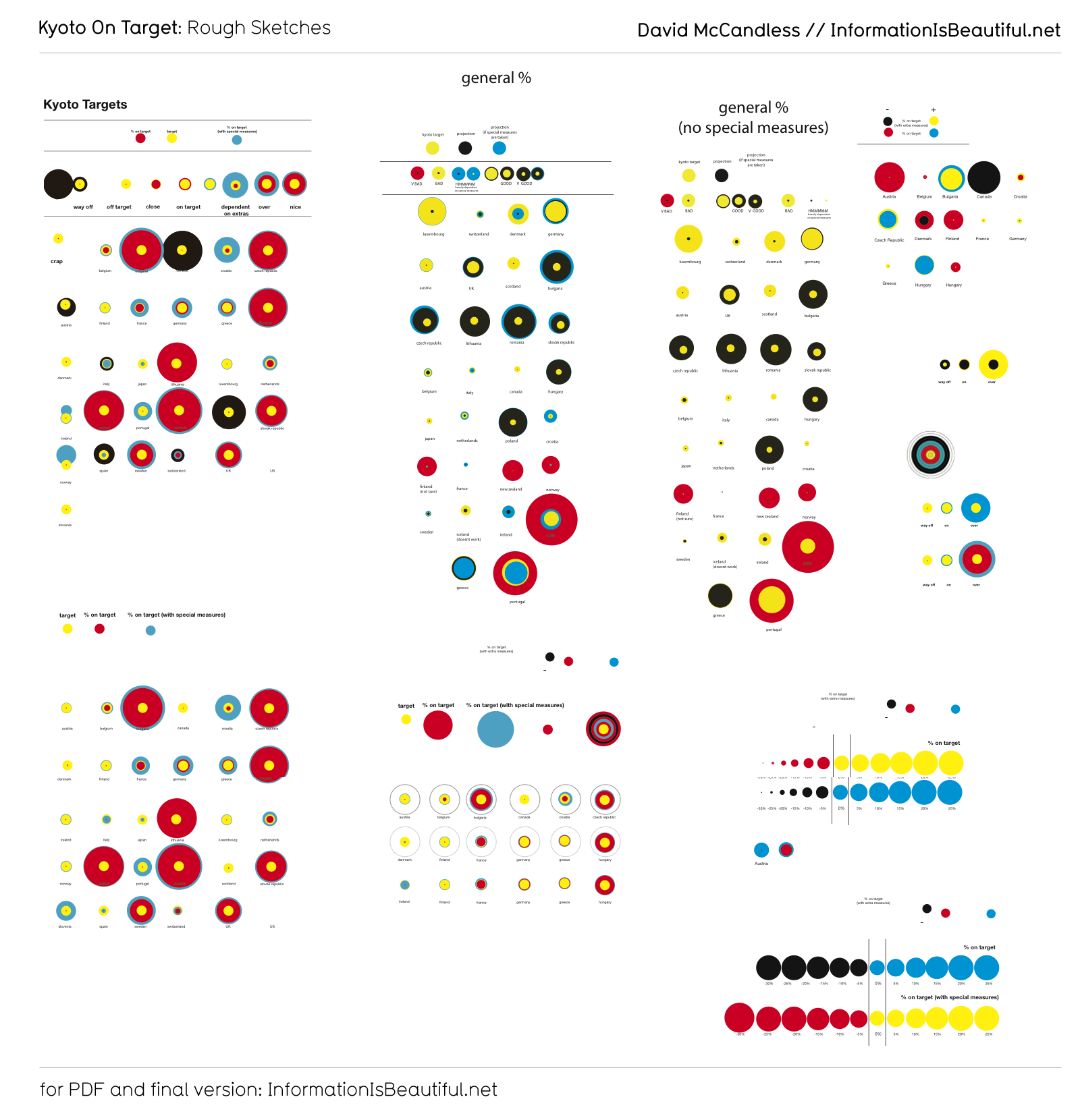
The design took several versions to get right. If you’re interested, you can see some drafts here (or as a PDF).
Posted in Climate, Data Visualisation, Environment, Infographic, News.
GET THE permalink
Post a comment or leave a trackback.


45 Comments

  1. Warren Pearce
    Posted October 2, 2009 at 12:10 pm | Permalink | Edit

    Many thanks for posting this. Interesting topic as I’ve been trying to tackle something similar at a local level. This is beautifully designed, but I’m struggling a little bit with interpretation (probably just me being dense). What’s the significance of the different size of the dots and the ordering of the colours within each country?

    If you could explain the figures for a couple of countries, that would probably help a lot. Thanks in advance…

  2. Jacob
    Posted October 2, 2009 at 12:29 pm | Permalink | Edit

    Very interesting + clean visualisation. Wouldn’t have thought England was so on target (depends on the targets, I guess). How comes the Big Boys are left off? (ie US, China, Russia, India)

  3. vali
    Posted October 2, 2009 at 12:34 pm | Permalink | Edit

    As ever, great work!

  4. telepilot
    Posted October 2, 2009 at 1:14 pm | Permalink | Edit

    Great graph! Takes one or two reads but then it shows a lot. I am a bit confused however – what does the size of the bubbles mean? E.g Italy – very tiny whilst Scotland is huge?

  5. david
    Posted October 2, 2009 at 2:08 pm | Permalink | Edit

    @woz Yeah I thought it might be the case that it’s a little hard to read. The yellow dot in the centre is the each countries target. The surrounding colour represent the various targets proportional to the yellow target.

    If the red circle (% on target) is larger than the yellow, the country is doing well.
    If the red circle is smaller than the yellow, it’s doing badly
    If the blue circle is larger than yellow, the country is relying on ‘extras’ to hit its targets.
    If the country has a white circle, its emissions have actually increased. It’s substantially under-target.

    Hmmmm. Explaining a visualization feels a bit counter to the point of them. Ho-hum. Lesson learnt.

    David

  6. david
    Posted October 2, 2009 at 2:09 pm | Permalink | Edit

    @jacob howard – i left US, China, Russia and India as I couldn’t find primary data for them.

    If anyone else can, please let me know.

  7. Gavin McP
    Posted October 2, 2009 at 3:25 pm | Permalink | Edit

    Good effort, but the figures for England and Scotland look wrong.

    Firstly, they don’t have separate Kyoto targets – only the UK has a target. Secondly, Scotland is festooned with windfarms, and has helpfully shut down almost all large manufacturing since 1990. It looks to me like you’ve allocated the resultant carbon savings to England.

    However, I like the idea, though I agree it’s a bit hard to decipher.

  8. Posted October 2, 2009 at 4:07 pm | Permalink | Edit

    Great blog, but this visualisation is appalling. The fact that you need to re-explain it in the comments says it all. Honestly, a stacked bar with a midpoint at the country target, then countries’ performance on a vertical axis, with a colour adjustment for ‘extras’ would have been an awful lot easier to interpret. This is about making data accessible, after all.

  9. Lluis C.
    Posted October 2, 2009 at 4:49 pm | Permalink | Edit

    I love your work, but I still cannot make much sense of this one… there’s something that I cannot grasp. On the contrary the graph by the European Enviromental Agency seems very clear to me, despite being much less beautiful.

    I think the trouble I have understanding this graph is that if the country is performing good, the red bubble is big, but in my mind when you talk about emissions the smaller they are the better.

  10. david
    Posted October 2, 2009 at 5:28 pm | Permalink | Edit

    thanks all for your comments and your barbs.

    yep, we’re edging into Fail territory with this one. Guess I took the metaphor too far. A good lesson ;)

    D

  11. Posted October 2, 2009 at 6:58 pm | Permalink | Edit

    Maybe, if the circles were aligned to one side instead of centered, it would be clearer that the size of the circle represents the value. Currently, it seems from the first sight that the either the visible area defines the value or the part of the radius of a specific color.

  12. Posted October 2, 2009 at 7:01 pm | Permalink | Edit

    And also I think that it’s more understandable when green and white defines the “goodness” and red and black defines the “badness”.

  13. Shannon
    Posted October 2, 2009 at 7:26 pm | Permalink | Edit

    David – I have to agree with folks that this one is hard to parse :) A noble effort though! By the way, very awesome of you to post the raw data in Google Docs, but I’m having trouble accessing it – is it still locked down at the moment?

  14. daniel
    Posted October 2, 2009 at 8:15 pm | Permalink | Edit

    The US figures don’t matter, given your title and premise, as the US was not a signatory to the first Kyoto Agreement. G W Bush didn’t believe in human caused or any global warming–or at least that’s what the leaders of the Us energy industry told him to believe. this round will be different–the US will be in it.

  15. Posted October 2, 2009 at 8:41 pm | Permalink | Edit

    Yeah, it’s a great idea, but very confusing. I would recommend just having a black circle as the target and filling it up from the inside with green (cos green is nice) to the degree that it’s been met. You could have a different shade of green for the “extras”.

    Would also be nice to see countries who are not Kyoto signatories somewhere on there, that could be hard. Maybe a single big target representing the whole world signing Kyoto, and this has been “met” to the degree that countries has signed up – but weighted by each countries emissions…

  16. Posted October 2, 2009 at 8:41 pm | Permalink | Edit

    I mean a black outline circle filled with white. a green & black circle would look horrible.

  17. david
    Posted October 2, 2009 at 8:42 pm | Permalink | Edit

    @shannon Sorry the Google Doc was locked for some reason. Here it is

    http://spreadsheets.google.com/ccc?key=0AmCeWwNKr6FmdGZLWGotWGNfcUtYWmkyalJIb21vbnc&hl=en_GB

  18. Warren Pearce
    Posted October 2, 2009 at 9:29 pm | Permalink | Edit

    David, thanks for commenting so quickly.

    Amount you have to ‘explain’ a visualisation is a tricky one. I quite like having figures on bar charts, for instance, but know it goes against Tufte’s ‘data-ink’ ideas. Also, just because something is not *immediately* comprehensible doesn’t necessarily mean it’s a bad viz when trying to convey complex stuff (although suppose audience matters for this too e.g. academic vs. newspaper). For this one, an example country might have helped with annotations to explain.

    Agree with Lluis C. that the bar chart is fairly easy to interpret. However it looks horrible, so worth a stab at something else. We learn more from our mistakes than our successes.

    Keep it up please, love the site!

  19. Alexander Gee
    Posted October 2, 2009 at 10:55 pm | Permalink | Edit

    I honestly do not understand this graph at all. Is it supposed to represent total carbon output or is it delta of carbon output? Circles were a bad choice is the radius the unit of measure or the area?

  20. Posted October 2, 2009 at 11:35 pm | Permalink | Edit

    Why is UK shown as England and Scotland – what about Wales and Northern Ireland?

  21. Chas
    Posted October 3, 2009 at 1:37 am | Permalink | Edit

    Where did you get the England / Scotland data from? There’s no mention of them in that EEA report you link to, since neither E nor S is a member state: the UK is.

    Your Scotland graph looks dodgy to me.

  22. Chas
    Posted October 3, 2009 at 2:02 am | Permalink | Edit

    Scotland’s emissions fell 13.4% over the period from 1990 – 2006 (last year data is available).

    The UK’s Kyoto target is a 12.5% cut over the period 1990 – (average of 2008-12).

    Therefore if Scotland had a Kyoto target (it doesn’t because it’s not a nation state – only the UK has a Kyoto target) it would have already met it.

    http://bit.ly/rRSQe

    But of course this argument is pretty much irrelevant because we know the emissions cuts agreed in Kyoto were nowhere near enough to ensure global warming doesn’t rise above 2 degrees C. In fact the Scottish Parliament has just set in law a reduction in emissions of 42% by 2020 (on 1990 baseline), which is about what the IPCC says is necessary for developed nations:

    http://bit.ly/a1KAV

  23. Chris
    Posted October 3, 2009 at 4:24 am | Permalink | Edit

    Where’s Australia!?
    I know we are behind, but would love to know by how much. :D
    Thanks.

  24. Posted October 3, 2009 at 4:42 pm | Permalink | Edit

    Hard to grasp at first, but it seems so intuitive once you explained it in the comments. (Guess that’s not a success, though.)

    @Jacob The US didn’t ratify the Kyoto Protocol, meaning we, unfortunately, never said that we would commit to this. At least now we have a bill to force car makers to increase fuel efficiency, but we’re definitely not doing our part!

  25. Andy
    Posted October 3, 2009 at 8:36 pm | Permalink | Edit

    Sorry, but I’m not sure I understand the meaning of the white circles here. At first it seems like the data is redundant with the red circles. That is, that the smallness of the red circle corresponds to the largeness of the white circle. However, if it represents a red circle with ‘negative’ radius then I don’t understand why there are red circles at all (that there could be blue circles makes some sense).
    Overall I like it alright (not as much as your other, beautiful, work), but I think the ‘On Target’ category is misleading and perhaps should be excluded entirely. Also, the % nomenclature is confusing to me, as I’m not sure whether you mean percentage of the target or percentage of emissions.

  26. tuacker
    Posted October 3, 2009 at 10:06 pm | Permalink | Edit

    The USA actually never signed, better said ratified, the Kyoto Protocol. So there is no target to accomplish, this would probably explain the lack of data.
    China sort of thinks its unfair to compare them to other countries as they make up a huge amount of the world population.

  27. Posted October 5, 2009 at 5:46 pm | Permalink | Edit

    Fabulous visual David! I will certainly be purchasing your book, especially as I am a visual learner.

    In case you have not come across it, this is a great site for emissions data: http://cait.wri.org/ (Climate Analysis Indicator Tool from the World Resources Institute). It is free to sign up and use.

    All my best!

    Zoe

  28. Ashlee
    Posted October 6, 2009 at 3:05 am | Permalink | Edit

    Hi David
    This is the first time I’ve seen your blog, but interested by efforts to think differently about quickly/effectively communicating info on climate change.

    Alas, I have to agree with many of the above comments, including your own that this isn’t quite there yet, but I think a simple refinement could go a long way. Why not start every country with a large circle to represent their target. I would go for red, as it’s has strong visual associations with danger/bad as well as a bullseye. Then fill in as much %-wise of the circle in yellow or green as they have come towards meeting the target (fill in so that there is a yellow/green circle in the middle of the red circle; so countries who had met 100% of their target would have entirely covered over the red target entirely, and for countries who are only meeting 50% of their target, the radius of the yellow/green circle would be half the radius of the red circle). Similar to the suggestion above, you could use a second shade of green to show ‘extras’. For countries that have met 0% of the target and are instead still increasing from 1990 levels, you could use a dashed red line set out a distance beyond the red target circle to show how much they are actually extending the amount of additional yellow/green reducing they will need to do to meet the target now.

    That all sounds a bit mucky in writing, but I’m not sure how to add visuals into the comments. Also, would highly recommended an examples based key per suggestion above where you point out the significance of each layer of the circle – would need to have at least two examples though; one for a country that was partially meeting its target, and one for a country that was failing plus increasing its emissions. A third to show a country meeting through a mix of in-country reductions and ‘extras’ would also be helpful.

  29. Posted October 6, 2009 at 1:38 pm | Permalink | Edit

    Obviously the success of a visualisation is determined by how many people understand it, however I’d like to stick my oar in and say that I personally did understand the graph (after reading the key a couple of times admittedly) and actually found it really easy to refer and compare between the different nodes.

    So a well done from me, and if one minor ball drop means the kind of quality 99% of the time on this site then I say keep it coming!

  30. Balazs
    Posted October 6, 2009 at 9:31 pm | Permalink | Edit

    The reason, that almost all CEE (Central-East European) countries are on target: after 1990 socialism ended, and much of the heavy industries were shut down in the following decade due to economic and efficiency reasons, and never opened again. ‘It’s only “luck” that this region meets the target.

  31. Posted October 8, 2009 at 5:34 pm | Permalink | Edit

    I actually thought this was pretty easy to interpret. However, I don’t understand how the “bullseye” category is doing better than the “on target” countries. Isn’t a larger red circle the goal?

  32. Posted October 9, 2009 at 10:33 am | Permalink | Edit

    There are many countries left here even mine also………The population of china is too large so u have to add it. It make a major difference in any subject.

  33. Posted October 9, 2009 at 10:53 am | Permalink | Edit

    I fully agree with the purpose, but a few remarks on graphic semiology and the use of color regarding representation of data. Granted, combining the criteria selected in such a graph ain’t easy.
    For rates of change red (or black) is typically used for positive values and cool colors (or white) for negative change, but culturally red is associated with danger or negative things and cool colors (green or blue) with nature… Somewhat confusing.
    Also the circle sizes vary but no key is given. In graphic semiology, surface is proportional to quantity, not diametre. Given that the yellew circle is 100% of the target, how do you read the surface ?
    Off hand, I would suggest using larger empty circles with black perimetres to represent target values, and an colored circle to represent the projection of the % attained, while the color would indicate % of dependacy on “extras” (carbon trading).
    Nonetheless, the idea is interesting.

  34. Posted October 9, 2009 at 10:58 am | Permalink | Edit

    Errata : last paragraph of rpreceding post should read :
    “Off hand, I would suggest using larger empty circles with black perimetres to represent target values, and an INNER colored circle to represent the projection of the % attained, while the color would indicate % of dependacy on “extras” (carbon trading).
    Nonetheless, the idea is interesting.”

  35. Chris
    Posted October 13, 2009 at 11:09 am | Permalink | Edit

    If it’s any help I was able to understand the visualisation. Not as quickly as your other ones though. It did take some thinking but once you’ve worked it out it’s a very good way to show and explain the data. I like it. We’ve printed it out and hung it in the office here as we’re doing a lot of work on this locally right now.

  36. Gloria
    Posted October 18, 2009 at 12:30 pm | Permalink | Edit

    Hi

    Thanks for informationisbeautiful.net, I adore your site!
    However, I can’t efficiently get any information out of this post. (Don’t get me wrong:I really
    _love_ this site, it’s a genious idea)
    I read “Information Dashboard Design” by Stephen Few, which I think is quite good, and at the bottom of page 60 he writes about using circles to visualize information. He suggests not to use circles like that because it makes it nearly impossible to read information out of them.
    Sorry for criticising your work & looking forward to your next post!

  37. Posted October 19, 2009 at 7:53 pm | Permalink | Edit

    great work, but the same can’t be said about the countries in the fail category.

  38. Biff
    Posted October 25, 2009 at 12:48 am | Permalink | Edit

    Correcting some misinformation about the US: The US is a signatory to the Kyoto Protocol, but neither Bill Clinton nor George W. Bush nor Barack Obama ever submitted it to the US Senate for final ratification. Shortly before becoming a signatory to the agreement, the US Senate unanimously passed the Byrd-Hagel Resolution, which more or less declared the Kyoto Protocol to be dead on arrival unless it was significantly modified. Since 41 Democratic Senators voted for the Byrd-Hagel Resolution (with four abstaining), blaming the failure of the US to ratify the treaty on George W. Bush seems pretty simplistic.

    …and yeah, the graphics, while creative, are a little confusing.

  39. Posted November 6, 2009 at 10:10 am | Permalink | Edit

    Although is there a chance that it’s a little more intuitive with red in the middle… or, perhaps with red as the target and other colours. I don’t know… that takes away from the familiarity!

  40. Posted November 13, 2009 at 10:34 am | Permalink | Edit

    Hi David,

    Interesting visualisation, thanks.

    LowCarbonEconomy.com are about to launch an exciting new climate change data project.

    1. We found a good source for the data I think you were after for this: http://dataservice.eea.europa.eu/dataservice/metadetails.asp?id=1080 (if that’s helpful at all)

    2. Would be really interested to talk to you about making the data we’ve collected beautiful too. Please do contact me if you’re interested.

    Cheers,

    David

  41. Posted November 25, 2009 at 8:36 pm | Permalink | Edit

    Would be useful to see the overall picture for all countries as this isn’t really a competition between countries.

  42. baboon
    Posted December 8, 2009 at 6:24 am | Permalink | Edit

    All countries that are “on target” are Easter European countries that de-industrialized after the fall of the Soviet Union and Warsaw Pact. Thats a measure of success, all right – go back to the caves and export your population for menial jobs in the West.

  43. Djurre Kroon
    Posted April 15, 2010 at 11:45 am | Permalink | Edit

    My first impression is that this one looks attractive, but it takes too long to intuitively understand which in my eyes is a prerequisite for a successful visualisation

  44. shane
    Posted April 18, 2010 at 3:28 pm | Permalink | Edit

    Canadas fail is caused by the oil sands out CO2 output will increase at a decreasing rate till 2020 then start dropping off, we are doing our part to reduce CO2 in the rest of the country though

  45. Alison Jenner
    Posted July 14, 2010 at 9:37 pm | Permalink | Edit

    Very interesting (love the site); and good to see England is doing well, even though Scotland performing less well. But – Wales is aiming to be a Fair Trade Nation; is committed to Sustainable Development and ESDGC is being/to be integrated into school curricula. Can you show Wales’ performance at all?

13 Trackbacks

  1. By Kyoto: Who’s On Target? « worldwide star on October 2, 2009 at 2:27 pm

    [...] read more on: Information is Beautiful [...]

  2. [...] via informationisbeautiful.net [...]

  3. By links for 2009-10-02 « Fantasising Zombies on October 3, 2009 at 2:03 am

    [...] Information Is Beautiful- Kyoto: Who’s On Target? great visualisation: sweden and england are on target but canada and scotland fail a big way (tags: infographics visualization global_warming) [...]

  4. By Notes for 10/4/2009 at MasterMaq's Blog on October 5, 2009 at 5:55 am

    [...] It’s a little tricky to read, but if you take a moment this visualization is great – Kyoto: Who’s On Target? [...]

  5. By The Outliers on October 9, 2009 at 4:28 am

    Thoughts on Kyoto: Who’s On Target from Information is Beautiful…

    If you haven’t seen it already, Information is Beautiful posted a wonderful inforgraphic the other day on the Kyoto Protocal Targets. (I’ll just reproduce a fragment here).
    I KNOW! I did diss Information is Beautiful previously, but I like …

  6. By The Kyoto Target « Globo Diplo on October 13, 2009 at 5:35 am

    [...] October 12, 2009 · Leave a Comment Sometimes an image really does speak more than a thousand words.  Cheers to this info graphic: [...]

  7. [...] Speaking of which, since I drafted this post, David over at Information is Beautiful has crafted this visual representation of post-Kyoto performance: [...]

  8. By Kyoto: Who’s On Target? « Zinger on October 15, 2009 at 5:25 pm

    [...] Who’s On Target? Kyoto: Who’s On Target?: [...]

  9. By Las Aventuras de Vitinho on October 15, 2009 at 6:40 pm

    Blog Action Day 2009…

    Ilustración: Information is Beautiful…

  10. By Kyoto: Who’s On Target? on November 3, 2009 at 9:46 am

    [...] 02.10 Kyoto: Who’s On Target? How is each nation doing? » email me » back to davidmccandless.com homepage [...]

  11. By Putting billions into perspective « nic combe on December 2, 2009 at 4:34 pm

    [...] by David McCandless who tries to visualise everyday data from the Guardian in a meaningful way. The Kyoto: Who’s On Target? went down particularly well with the engineers in the sustainability group at work ahead of the [...]

  12. [...] an infographic showing which countries have lived up to the Kyoto agreement on the environment and which have [...]

  13. [...] Ένα infographic για τις χώρες που συμμορφώθηκα με τη συμφωνία του Κυότο και όσες την έγταψαν στα παλιά τους τα κατάστιχα… [...]

Post a Comment

Your email is never published nor shared. Required fields are marked *

*
*

You may use these HTML tags and attributes: <a href="" title=""> <abbr title=""> <acronym title=""> <b> <blockquote cite=""> <cite> <code> <del datetime=""> <em> <i> <q cite=""> <strike> <strong>

  • Like this? Subscribe for more
    Web Feed Twitter