Swine Flu Latest: Visualized!

With the help of the excellent Guardian Datastore, we’ve been tracking Swine Flu (“novel H1N1 virus”) as it creeps across the globe and starts to feeds into the autumnal ‘flu season. There are some surprising results.

Is the US about to face a pandemic?

The USA still has the most cases in the world. The America media are starting to pump out alarming headlines. “200,000 deaths!”. Here are the current figures.
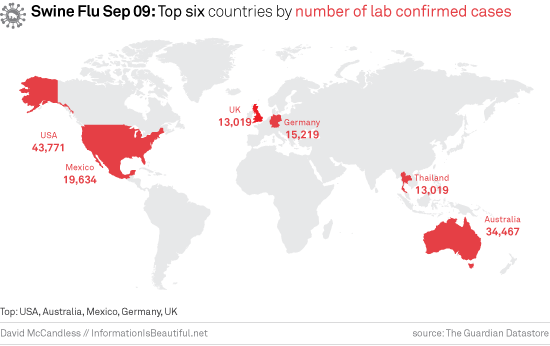
Swine Flu: Countries with most cases Sep 2009
But when you factor in population sizes, the USA disappears off the map. (It’s actually 15th in the world)
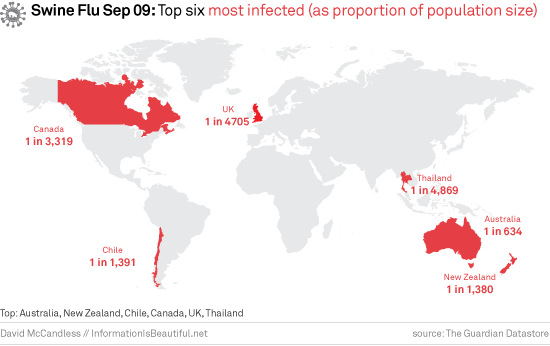
Swine Flu: Most Infected Countries Sep 2009

Fatality rates: Is Swine Flu getting deadlier?

When you look at fatality rates for Swine Flu, the percentage of infected people who die, the results are depressingly unsurprising.
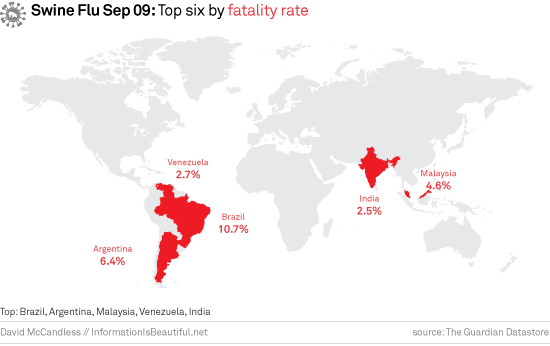
Swine Flu: Fatality rates around the world Sep 2009
Although these nations have much fewer cases than Western nations, far more people are dying. Brazil’s fatality rate is a shocking 10%, against a world-wide average of around 0.3-0.5%.

When you compare these worldwide fatality rates against those from mid-July, you see a slightly worrying trend.
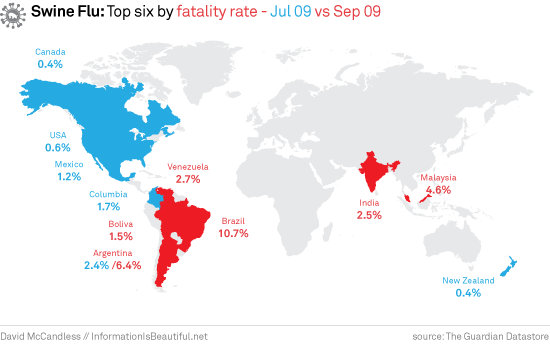
Swine Flu: Fatality rates July 2009
Swine Flu appears to be becoming more deadly in Latin America. Is this down to Western nations use of Tamiflu?

Swine Flu Advisory

Here’s the overall data in a table. Media reporting generally only focuses on the first column. But we think the other columns are more relevant.

The stand-out statistic from all this is the US’s death rate at 1.2%. It’s the only Western nation in the above-average rankings.

This may be down to Swine Flu’s particularly lethal interaction with obesity. An estimated 34% of American’s are obese (CDC)

Swine Flu Advisory: September 2009

If you are interested in more, you can see a live interactive table of Swine Flu figures here.
Sources and data in this Google Doc.

Posted in Comparison Chart, Data Journalism, Disease, Health, News, World Map.
GET THE permalink
Post a comment or leave a trackback.


30 Comments

  1. Posted September 1, 2009 at 12:13 pm | Permalink | Edit

    Nice graphs.
    About why is the flu more lethal in the south hemisphere, I’ll say it has to do with winter. I bet ours will raise in the next months.

  2. Posted September 1, 2009 at 1:55 pm | Permalink | Edit

    Your graphs are poetry! Bravo! Simply amazing…

  3. Rafael Gaviria
    Posted September 1, 2009 at 3:34 pm | Permalink | Edit

    Very interesting visuals! Just one minor correction: The south american country is called “Colombia” and not “Columbia”….(common mistake)

  4. Pete
    Posted September 1, 2009 at 4:21 pm | Permalink | Edit

    Good point Naeros

  5. Martin A
    Posted September 1, 2009 at 5:04 pm | Permalink | Edit

    Variations in underreporting of non-fatal infections is a more likely explanation for the difference in fatality rates.

  6. jamie
    Posted September 1, 2009 at 5:59 pm | Permalink | Edit

    “Swine Flu appears to be becoming more deadly in Latin America. Is this down to Western nations use of Tamiflu?”

    Probably not. I would have thought seasonal, no?

  7. Posted September 1, 2009 at 6:43 pm | Permalink | Edit

    Sadly your data source (http://www.guardian.co.uk/news/datablog/2009/apr/27/flu-flu-pandemic) seems bogus to me. They’re now using a mish-mash of sources, some of which are estimates and some that are official. Some of the sources have not been updated in months. Others are updated sporadically. Overall, the Guardian Datastore is not doing a good job of indicating the reliability of the data in their final spreadsheet. Separately, there seem to be a couple of fundamental and obvious formula errors in their linked spreadsheet.

    Any visualizations you produce based on that bogus data would seem to be fundamentally flawed.

  8. GBR
    Posted September 1, 2009 at 8:37 pm | Permalink | Edit

    Don’t get carried away by the mortality rates in South America. Governments down here are only testing a small percentage of suspect cases, and focusing on young children and pregnant women. A more reliable indicator is deaths over total population. In this case Agentina jumps to the top of the table. The maps are pretty useless.

  9. Posted September 1, 2009 at 10:25 pm | Permalink | Edit

    As Martin and Stephen say, the underlying data is probably not that useful for drawing these conclusions.

    “WHO will no longer issue the global tables showing the numbers of confirmed cases for all countries.”

    “For countries already experiencing community-wide transmission, the focus of surveillance activities will shift to reporting against the established indicators for the monitoring of seasonal influenza activity.” [WHO]

  10. david
    Posted September 2, 2009 at 8:37 am | Permalink | Edit

    great – thank you very useful. I’ll add another “deaths over total population” column to the table.

  11. Posted September 2, 2009 at 1:03 pm | Permalink | Edit

    David,

    Thanks for putting this info into perspective. I’m so sick of the news media reporting meaningless numbers with no comparisons. It’s nice to have someone like you creating cool visuals that show the real story.

    Even if the data sources aren’t as accurate as we would like, this article’s information is still more valuable than the “Oh my God, there’s 43,371 swine flu cases in the US, we’re all gonna die!” garbage that we would be reading or hearing otherwise.

  12. Paul Boudreaux
    Posted September 2, 2009 at 11:51 pm | Permalink | Edit

    I really do like your use of graphs over some of the journalism I have been seeing. None the less, it would be nice to be able to interact more with the graphs, or perhaps more ridiculously – post a comment with a map chart based on the variables used to make the data…

    Still, I would say the “mortality rate” is a bit sensationalistic. Perhaps the culture in Brazil is such that people are less inclined to go to the doctor unless they are particularly sick?

    I’d say a much more honest chart would be showing fatalities to the total population… Put that figure in ratio to the previous year or two (or average) of flu fatalities by the total population, divide by an appropriate figure of time (perhaps do this by the month (x/12) over several months to show the increasing spread), and you get a sort of Swine Flu power ratio compared to other flu’s. I admit it should not be in season yet, and so this ratio should be increasing – but I think it would give a very clear perspective of how bad the swine flu is (which it really isn’t). I mean, where would you expect this number to end up each month? Is it 2… 5… 500? Without this kind of data, how in the world can anyone make a rational claim about it beyond the AP screaming that the sky is falling and millions of Americans are suffering from the swine flu?

  13. Francisco
    Posted September 3, 2009 at 12:44 am | Permalink | Edit

    “Swine Flu appears to be becoming more deadly in Latin America. Is this down to Western nations use of Tamiflu?”

    In the southern eastern (?) Latam countries, such as Chile no, there is more Tamiflu than needed, but we are in winter. As a matter of fact, in the Southern regions of Chile and Argentina the mortality is significantly higher, and there is precisely where the winter is significantly colder. In the western (???) the swine flu ocurred on summer/spring

  14. Debra Smith
    Posted September 3, 2009 at 1:33 am | Permalink | Edit

    The interesting factors remain that the highest death rates are in the Southern hemisphere and that we have not had our proper flu season yet. Flu does not normally occur in the summer and it certainly does not cause deaths in the summer. If people were dying of frostbite in the summer someone might stand up and say “Wow, this is something we should pay attention to.” Pandemic flus are by their nature difficult to predict. They mutate, they act differently. I respectfully ask people to read the Nature article from a couple of months ago and I also ask what is so wrong with being prepared?

  15. Posted September 3, 2009 at 3:05 am | Permalink | Edit

    The New York Times ran an article today about Mayor Bloomberg’s plan to vaccinate school children. See our graphic capture of the article: at our daily illustration blog

    Nora

  16. Martin
    Posted September 3, 2009 at 6:11 am | Permalink | Edit

    Great Post!
    I minor issue. It’s Uruguay with g (not Uruquay with q) :)

  17. Question
    Posted September 3, 2009 at 11:15 am | Permalink | Edit

    Did you use Processing to produce such beautiful graphs?

  18. Posted September 3, 2009 at 12:01 pm | Permalink | Edit

    I believe that under-reporting is a LARGE issue as well (as I’ve seen another poster mention). i live in Florida, and recently went though a bought of flu. I was very sick, totally filled with mucus (sorry) to the point it was coming from everywhere. I almost went to hospital, but was too sick to think and was unconscious for two days. i just tonight felt better, and now feel fine after six hours awake. this whole ordeal lasted 4 1/2 days. I wonder if i had it, and if so, how many others have had it and not been too the doctor?

  19. david
    Posted September 3, 2009 at 2:45 pm | Permalink | Edit

    No. Adobe Illustrator CS3.

  20. Sarah
    Posted September 4, 2009 at 5:24 pm | Permalink | Edit

    Talented guy (gal?)…

    Currently doing a report on global healthcare trends. I wish my graphs looked as pretty as yours…

  21. Posted September 6, 2009 at 8:15 am | Permalink | Edit

    don’t you find interesting that rich countries have more cases, and poor countries more deaths ? I doubt that England has mora cases, in absolute numbers than Brazil. What happens though is that Brazil has no control at all of people infected. It is only known when they are already dead. More, do you think countries like Bolivia and Venezuela, that now are being administrated by almost dictators, will provide reliable numbers about such delicate subject?

    Just to think about.

  22. David Burrows
    Posted September 6, 2009 at 8:29 pm | Permalink | Edit

    Isn’t the percentage of deaths more related to general health care standards in the country than a more virulent virus? Mapping WHO child mortality rates from 0-4 years onto your “percentage infected who die” chart there’s definitely some grounds for correlation – i would think most of the abberations (e.g. India’s mid table position) would dissapear when (hopefully if!) numbers of infected become statically relevant to the population sizes

    brazil 23
    argentina 19
    Malysia n/a
    venezuela 21
    india 95
    bolivia 34
    peru 18
    usa 5
    spain 3
    singapore 1.1

  23. Posted September 7, 2009 at 8:36 am | Permalink | Edit

    Excellent article, but one minor gripe, the bold column-labels on the SWINE FLU ADVISORY table are a confusing to me.

    The first two columns “Most cases?” and “Most infections?” mean the same thing, because each case is an infection.

    The “Most infections?” column is really asking “highest infection rate?”. An alternate phrasing might be “Most contagious?” or “Most infectious?”

    The bold headings on the last two columns are identical (“Most deaths?”) even though they measure different things: survival-rate once contracting H1N1 and the chances of dying of H1N1. Put another way, mortality rate: {if you have H1N1 and live in the country, if you live in the country}

    I was thinking “Most virulent?” and “Most dangerous?” might work. But while technically more correct, virulent and dangerous are nearly synonymous. Perhaps “Most unsurvivable?” and “Most dangerous?” I’m not coming up with anything better that fits the “Most XXX” pattern.

  24. Andre
    Posted September 8, 2009 at 11:09 am | Permalink | Edit

    Confirmed lab cases in South Africa and other African countries are freely available and its rising daily. These are CDC and WHO confirmed result in recognized laboratories

    So, it would seem as if you dont have the data to make the correct comments.

    Considering that the World Soccer cup will be held in South Africa the outbreak here should be a focal point as re-infection of the world can occur.

  25. Posted September 9, 2009 at 8:53 pm | Permalink | Edit

    Hi,
    I was sent to your site, by a Facebook friend, who posted one of your graphs “The Hierarchy of Digital Distractions”, which than led me to browse through some of your other posts. I have to conclude you, my friend, are a rarity and the information you provided along with the supporting links, and the commentary following each, is awesome! I am not one who would say (she) is intelligent, but can certainly appreciate when facts are aligned with conclusions that provide un-sensationalized outcome. If that makes sense? Anyway, I hope you can do this graphical representation for my industry: mobile – I’m curious to see the total number of mobile users world wide, the representation of carriers for each country, etc. You should market this data in a book! — or I suspect that’s already in motion!

    Thanks for putting this out into the world wide web of information. It is interesting to say the least.

    Cheers,
    Shelly

  26. Riley
    Posted September 12, 2009 at 12:09 am | Permalink | Edit

    Awesome graphics. One problem, Canada is actually much larger than it is displayed, you have missed all the northern islands.

  27. Lucie Melahn
    Posted September 24, 2009 at 10:55 pm | Permalink | Edit

    It’s a beautiful graphic, but there is a major factor that is not being considered in most of these discussions. To say that American cases are milder is jumping to conclusions. The US has by *far* the most testing facilities and the highest rate of testing for H1N1, so clearly we are going to have the highest number of confirmed cases. Is it more lethal in the southern hemisphere? it is hard to say, because only the very sickest people were tested for H1N1, while most of the rest were not. I have a suspicion that the true mortality rate in the southern hemisphere is far lower.

  28. Posted October 28, 2009 at 5:28 pm | Permalink | Edit

    Something else that should be noted is that the Southern Hemisphere went through its entire flu season without having access to any H1N1 vaccine, which is only now becoming available to citizens in the northern hemisphere, which is only in the first few weeks of its traditional flu season. It’s likely that the overall effects of H1N1 will be comparable to a traditional seasonal flu, provided the vaccine reaches the populations most vulnerable to complications from the disease. While H1N1 appears to be highly contagious, people vaccinnated against it will be better able to resist the disease, and if they do fall ill, are less likely to suffer life-threatening complications. Yes, you can still get sick even if you have been vaccinnated, but you’re still better off than being completely unprotected.

    Thanks for your wonderful work. Your site is delightful!

  29. Posted May 25, 2010 at 4:34 pm | Permalink | Edit

    Congratulations for this blog it’s really awesome!!!

  30. Trevor
    Posted May 25, 2010 at 6:36 pm | Permalink | Edit

    Hi! Your graphics are always amazing. However in your proportion of population size map you have erred in your cartographic interpretation of Canada. This was disappointing as I always hold your data up as examples of great work in my classes.

20 Trackbacks

  1. [...] the whole story here: david aggregated by [...]

  2. [...] Originally posted here: Swine Flu Latest: Visualized! | Information Is Beautiful [...]

  3. [...] Original post:  Swine Flu Latest: Visualized! | Information Is Beautiful [...]

  4. [...] Here is the original post: Swine Flu Latest: Visualized! | Information Is Beautiful [...]

  5. [...] Los datos de partida pertenecen a Guardian Datastore y las representaciones gráficas han sido elaboradas por David McCandless para Information is Beautiful. Quien lo desee, puede acceder a los datos en [...]

  6. [...] See the rest here:  Swine Flu Latest: Visualized! | Information Is Beautiful [...]

  7. By Gripe Porcina: Visualizada! « Chinelo Mix Blog on September 1, 2009 at 8:08 pm

    [...] via InformationIsBeautiful [...]

  8. By Tuesday Links | What Jamie Found on September 1, 2009 at 9:05 pm

    [...] style? Like there’s 1 guy out there who does it full time. Information is Beautiful graph. Swine Flu Latest: Visualized! PHD comic: ‘Peak Productivity’ http://ff.im/-7tXj5 Amazing demonstration of wireless [...]

  9. By Health media | Asia Health Care Blog on September 2, 2009 at 1:30 am

    [...] to Information is Beautiful that has a very nice visualization of swine flu, with their post: Swine Flu Latest: Visualized! Information presented in the right form speeds up communication, and this is a good example of it. [...]

  10. By Fresh From Twitter | Renzo Kuomo on September 2, 2009 at 3:39 am

    [...] Flu Latest: Visualized! http://bit.ly/VEsUl interesante visualizacion de la gripe A en el mundo Argentina esta segundo en muertesFacebook [...]

  11. [...] Swine Flu Latest: Visualized! | Information Is Beautiful [...]

  12. By Poniendo la gripe A en perspectiva : Blogografia on September 2, 2009 at 5:21 pm

    [...] los gobiernos, me parecen muy interesantes las infografías que ha publicado David McCandless en Swine Flu Latest: Visualized! con estos datos obtenidos de Full list of swine flu cases, country by [...]

  13. [...] aiuta David McCandless, un visual & data journalist londinese, che vuol dire che col suo blog fa giornalismo con numeri e grafici. David ci permette di andare a fare i conti in tasca alla [...]

  14. [...] aiuta David McCandless, un visual & data journalist londinese, che vuol dire che col suo blog fa giornalismo con numeri e grafici. David ci permette di andare a fare i conti in tasca alla [...]

  15. [...] aiuta David McCandless, un visual & data journalist londinese, che vuol dire che col suo blog fa giornalismo con numeri e grafici. David ci permette di andare a fare i conti in tasca alla [...]

  16. [...] los gobiernos, me parecen muy interesantes las infografías que ha publicado David McCandless en Swine Flu Latest: Visualized! con estos datos obtenidos de Full list of swine flu cases, country by [...]

  17. By H1N1: Rap, Second Life and Datasets « ScienceRoll on September 10, 2009 at 10:41 am

    [...] Swine Flu Latest: Visualized! [...]

  18. [...] came across an interesting infographic at Fast Company. The presentation was way clearer over at Information is Beautiful, one of my favorite sites and the originator of the [...]

  19. [...] Swine Flu Latest: Visualized! | Information Is Beautiful [...]

  20. By China Healthcare Blog | Health Media Clippings on January 9, 2010 at 5:57 am

    [...] to Information is Beautiful that has a very nice visualization of swine flu, with their post: Swine Flu Latest: Visualized! Information presented in the right form speeds up communication, and this is a good example of it. [...]

Post a Comment

Your email is never published nor shared. Required fields are marked *

*
*

You may use these HTML tags and attributes: <a href="" title=""> <abbr title=""> <acronym title=""> <b> <blockquote cite=""> <cite> <code> <del datetime=""> <em> <i> <q cite=""> <strike> <strong>

  • Like this? Subscribe for more
    Web Feed Twitter